Making compost at home is one of the simplest ways to improve garden soil while reducing everyday household waste. Many things that normally go into the rubbish bin can be turned into rich organic material for plants.
I used to think composting required a large garden, special equipment, or a lot of technical knowledge. After reading about natural soil improvement and observing how organic matter breaks down, I realized that composting is actually a simple natural process. With the right materials and a little patience, almost anyone can make compost at home.
The basic idea is easy. Kitchen scraps, dry leaves, cardboard, and other organic materials are collected together. Microorganisms gradually break them down and turn them into a dark, crumbly material called compost.
This homemade compost can then be added to garden beds, pots, vegetable patches, and around plants.
What Is Compost?
Compost is decomposed organic material that can be mixed with soil to improve its quality.
In nature, composting happens all the time. Leaves fall from trees, plants die, and organic matter slowly breaks down. Over time, these materials become part of the soil again.
Home composting simply recreates this natural process in a controlled way.
Good compost usually has a dark brown appearance and an earthy smell. It should feel loose and crumbly rather than wet and sticky.
When added to soil, compost provides organic matter and helps create better growing conditions for plants.
Why Make Compost at Home?
There are several practical reasons to make compost from household materials.
The first benefit is waste reduction. Many kitchen and garden materials can be composted instead of being thrown away.
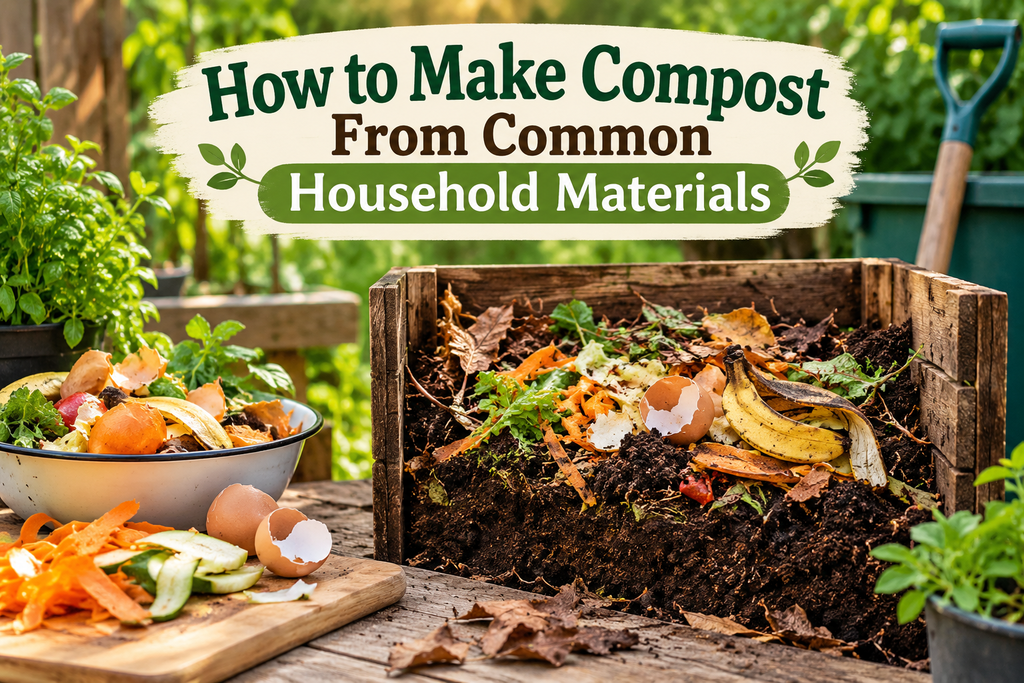
Fruit peels, vegetable scraps, tea leaves, dry leaves, and cardboard are common examples.
The second benefit is improved soil.
Compost helps soil hold moisture while still allowing excess water to drain. It also improves soil structure and creates a better environment for beneficial organisms.
Another advantage is cost.
Instead of buying bags of soil conditioner regularly, gardeners can create useful organic material from things already available at home.
For anyone trying to garden on a small budget, composting can be very useful.
Understanding Green and Brown Compost Materials
A healthy compost pile usually contains two main types of materials.
These are often called green materials and brown materials.
Green materials contain more nitrogen. They are usually fresh and moist.
Common green materials include vegetable scraps, fruit peels, fresh grass clippings, coffee grounds, and fresh plant trimmings.
Brown materials contain more carbon. They are generally dry.
Examples include dry leaves, shredded cardboard, paper, small twigs, and dry plant material.
A good compost pile needs both types.
Using only wet kitchen scraps may create a heavy, unpleasant mixture. Using only dry materials may make decomposition very slow.
Combining green and brown materials creates better conditions for composting.
Common Household Materials You Can Compost
Many ordinary household items can be added to compost.
Fruit and vegetable scraps are among the easiest materials to use.
Banana peels, apple cores, melon skins, carrot peelings, cucumber ends, and similar plant waste can all be composted.
These materials break down relatively quickly.
Tea leaves can also be useful. If tea bags are used, it is worth checking whether the bag itself contains plastic. Loose tea leaves are usually easier to compost.
Coffee grounds can be added as well.
Eggshells are another common household material. They break down slowly, so crushing them before adding them can help.
Plain cardboard is very useful as a brown material.
Delivery boxes, plain packaging, and cardboard tubes can be torn or shredded into smaller pieces.
Uncoated paper can also be composted in moderate amounts.
Dry leaves collected from a yard or garden are excellent compost material.
Small quantities of untreated sawdust may also be used, although large amounts can slow the composting process.
Materials That Should Not Go Into Home Compost
Not every household waste item belongs in a compost pile.
Meat, fish, bones, and oily food should usually be avoided in a basic home compost system.
These materials may produce strong smells and attract pests.
Dairy products such as milk, cheese, and yogurt should also be kept out of a simple garden compost pile.
Cooking oils and greasy food are not suitable either.
Pet waste from cats and dogs should not normally be placed in compost that will later be used around food plants.
Diseased plants should also be handled carefully because some plant diseases may survive under normal home composting conditions.
Plastic, glass, metal, foil, and synthetic materials obviously do not break down naturally and should never be added.
Glossy paper and heavily coated cardboard are also better left out.
Choose a Suitable Composting Location
The next step is choosing where to make the compost.
A compost pile can be created directly on the ground, inside a simple compost bin, or in a suitable container with ventilation.
A shaded or partly shaded location is often convenient.
Too much direct sun may dry the pile quickly during hot weather.
The area should also be easy to reach because kitchen scraps may be added regularly.
If the compost is made directly on soil, worms and other organisms may naturally enter the pile and help with decomposition.
People with small gardens can use compact compost containers instead.
Even a modest composting area can produce useful material if it is managed properly.
Start With a Layer of Brown Material
When beginning a new compost pile, I find it useful to start with dry material.
Place a layer of small twigs, shredded cardboard, or dry leaves at the bottom.
This creates small air spaces.
Air is important because many of the organisms that break down compost work best when oxygen is available.
After the first brown layer, some green material can be added.
For example, add vegetable scraps or fresh plant trimmings.
Then cover them with another layer of dry material.
This simple layering method helps keep the compost balanced.
Cut Large Materials Into Smaller Pieces
Large pieces of organic material take longer to break down.
Cutting or tearing materials into smaller pieces can speed up composting.
A large cabbage leaf, for example, will usually decompose more slowly than the same leaf cut into several pieces.
Cardboard can be torn into small sections.
Vegetable scraps can also be chopped before being added.
There is no need to cut everything into tiny pieces. The goal is simply to avoid large, thick materials that may take months to decompose.
Smaller pieces create more surface area for microorganisms to work on.
Keep the Compost Moist
Moisture is another important part of the composting process.
The pile should be damp but not soaked.
A useful comparison is the moisture level of a squeezed sponge.
If the compost becomes completely dry, decomposition can slow down significantly.
If it becomes too wet, air spaces may disappear and the pile can develop an unpleasant smell.
In dry weather, a small amount of water may need to be added.
During rainy periods, the pile may need some protection from excessive water.
Cardboard and dry leaves can also help absorb extra moisture.
Allow Air Into the Compost
Compost needs oxygen.
Without enough air, organic material may become compacted and begin to smell.
Turning the compost from time to time helps prevent this problem.
A garden fork or similar tool can be used to mix the pile.
There is no need to turn it every day.
Turning it every week or two can be enough for many small home compost piles.
Even occasional mixing can improve airflow and help materials decompose more evenly.
Balance Wet and Dry Materials
One of the easiest ways to manage compost successfully is to observe its condition.
If the pile looks very wet and smells unpleasant, add more brown material.
Dry leaves, shredded cardboard, and plain paper can help absorb moisture.
If the pile looks dry and nothing seems to be breaking down, add some green materials and a small amount of water.
This simple adjustment can solve many common composting problems.
There is no need to measure every ingredient exactly.
Learning to recognize the appearance and moisture level of the pile is usually more practical.
Cover Fresh Kitchen Scraps
Fresh kitchen waste can sometimes attract flies.
A simple solution is to cover newly added food scraps with dry leaves, cardboard, or existing compost material.
This keeps the surface cleaner and can reduce odors.
It also prevents the compost pile from becoming dominated by wet kitchen waste.
Whenever I add a container of vegetable scraps, I like to add some dry material on top.
This small habit can make composting much easier to manage.
How Long Does Homemade Compost Take?
There is no exact composting time because many factors affect decomposition.
Temperature, moisture, material size, airflow, and the type of waste being used all make a difference.
A carefully managed compost pile may begin producing usable compost within a few months.
A pile that is left mostly untouched may take longer.
There is nothing wrong with slow composting.
The materials will still break down naturally.
Gardeners who are not in a hurry can simply continue adding suitable waste and let nature do most of the work.
How to Know When Compost Is Ready
Finished compost should look very different from the original household waste.
Most of the materials should no longer be recognizable.
The compost should be dark, loose, and crumbly.
It should also have a pleasant earthy smell.
If large pieces of cardboard or vegetable waste are still clearly visible, the compost probably needs more time.
Some materials, such as small twigs or eggshells, may remain even when most of the compost is ready.
These pieces can simply be removed and returned to the compost pile.
How to Use Homemade Compost
Once the compost is ready, it can be used in several ways.
One of the easiest methods is to spread a thin layer over garden soil.
It can also be mixed into garden beds before planting.
For established plants, compost can be placed around the soil surface without touching the main stem.
It is also useful in vegetable gardens.
When preparing pots, compost can be mixed with other suitable growing materials rather than being used alone.
Compost improves soil gradually, so regular small applications can be more practical than adding a very large amount at once.
Using Compost Around Garden Plants
Compost can help create healthier soil around flowers, vegetables, shrubs, and many other garden plants.
Spread a layer around the root area and gently mix it into the upper soil if appropriate.
Avoid piling compost directly against plant stems.
Over time, watering and natural soil organisms will help move nutrients and organic matter deeper into the soil.
Compost can also help the ground remain moist for longer during warm weather.
This can be especially useful in garden beds that dry out quickly.
Common Composting Problems
Most composting problems are easy to correct.
A bad smell usually means the pile is too wet or does not have enough air.
Mixing the pile and adding dry material may solve the problem.
If the compost is not breaking down, it may be too dry.
Add some moisture and fresh green material.
If flies are gathering around the pile, cover fresh food scraps with brown material.
If the compost becomes very compact, turning it can restore airflow.
The main lesson is that compost should remain balanced.
It needs moisture, air, green materials, and brown materials.
Composting in a Small Home or Garden
People sometimes assume composting is only practical for large properties.
That is not true.
A small compost bin can work in a compact garden.
Households that produce limited food waste may actually find small compost systems easier to manage.
The important thing is to add suitable materials gradually.
Avoid filling a small container with large amounts of wet kitchen waste at once.
Add dry material regularly and keep the contents ventilated.
Even a small compost system can eventually produce enough compost for pots and small garden beds.
Make Composting Part of Your Daily Routine
The easiest way to continue composting is to make it part of normal household life.
A small container can be kept in the kitchen for fruit and vegetable scraps.
When it becomes full, the contents can be emptied into the compost pile.
Keep dry leaves or shredded cardboard near the composting area.
Every time kitchen waste is added, cover it with some dry material.
This simple routine only takes a few minutes.
Over time, the amount of household waste going into the rubbish bin can decrease noticeably.
Avoid Trying to Make Compost Perfect
Beginners sometimes worry about exact compost ratios.
While balance is important, home composting does not need to be complicated.
Nature is already doing most of the work.
If the pile becomes too wet, add dry material.
If it becomes too dry, add moisture and some fresh plant waste.
If it smells, improve airflow.
Observing the pile is often more useful than following complicated formulas.
With experience, it becomes easier to understand what the compost needs.
Be Patient With the Natural Process
Composting teaches patience.
Food scraps and dry leaves do not turn into finished compost overnight.
They gradually soften, shrink, darken, and break apart.
During this process, microorganisms, insects, fungi, and other natural decomposers work together.
The changes may seem slow at first, but after several weeks or months the pile can look completely different.
This natural transformation is one of the most interesting parts of home gardening.
Final Thoughts
Learning how to make compost from common household materials is a simple way to support a healthier garden.
You do not need expensive equipment or advanced gardening knowledge.
Start with materials you already have.
Use fruit and vegetable scraps for green material. Add dry leaves, cardboard, and paper for brown material. Keep the pile slightly moist, allow air to circulate, and give the materials time to break down.
Avoid adding meat, dairy products, oily food, plastic, and other unsuitable waste.
As the months pass, ordinary household scraps can gradually become dark, useful compost.
The finished compost can improve garden beds, pots, vegetable areas, and soil around established plants.
Once composting becomes part of your routine, throwing vegetable peels and dry leaves into the rubbish can begin to feel wasteful.
Instead, these simple materials can be returned to the soil, where they become useful again.